
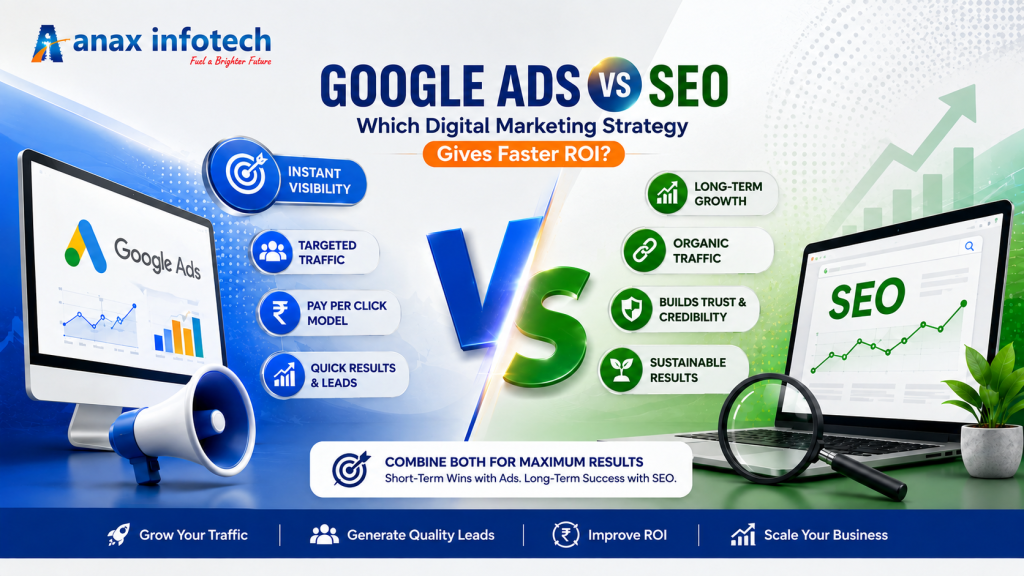
Google Ads vs SEO: Which Digital Marketing Strategy Gives Faster ROI?
If companies wish to enhance web traffic, get leads, and make more sales online, then the two most popular digital marketing methods are Google Ads and SEO. These strategies can both lead potential customers to companies via Google, although these methods function in completely different ways.
The first way is that Google Ads allows for immediate web traffic from targeted people, whereas the second option is focused on making the company’s web page organically visible. Therefore, which approach offers faster ROI? This question is based on many factors, including business goals, budget, competitiveness, and time needed.
In this guide, we will compare Google Ads and SEO, examine their benefits, prices, timeframe, and ROI potential.
What is Google Ads?
Google Ads is an advertising service provided by Google through which businesses are able to show their ads on Google search results and various other properties of Google. Usually, businesses have to pay whenever someone clicks on their ads.
Suppose that you do a search for SEO services in Tuticorin; in such a case, some advertisements would show up at the top of the search results.
Google Ads Benefits
- Quick generation of website traffic
- Prominence on Google right away
- Tailored keyword advertising
- Going after specific locations
- Simple tracking of campaign effectiveness
- Flexible budget for advertising
- Especially useful for creating quick leads and sales
The primary benefit of Google Ads is speed. Your business can begin getting its visitors quickly once the campaign has been approved and launched.
SEO: What Is It?
SEO, or Search Engine Optimization, refers to a series of actions that are designed to optimize your website in order to get a higher ranking in Google searches.
There are many things that go into the SEO process, such as keyword research, content creation, technical SEO, website optimization, link building, local SEO, and user experience optimization.
For instance, when trying to target the keyword “digital marketing services in Tuticorin,” you may build an optimized services page.
Advantages of SEO
- Creates organic traffic to your website
- Fosters long-term search engine visibility
- Can lessen reliance on pay-per-click advertising
- Promotes credibility of the website
- Supports lead generation continuously
- Offers long-term benefits
- Allows businesses to optimize various keywords
In contrast to Google Ads, SEO does not offer quick results. But a well-planned SEO strategy can keep creating organic traffic even after the payments for each click are over.
Google Ads Vs. SEO: Differences
| Criteria | Google Ads | SEO |
|---|---|---|
| Traffic | Pay-per-click traffic | Natural traffic |
| Timing | Quick | Slow |
| Costs | Must have money to pay | Must invest in SEO |
| Long-term effect | Reliant on ongoing ads | May continue after rankings increase |
| Keyword usage | Extremely controlled | Reliant on optimization and relevance |
| Effectiveness | May yield results quickly | May take time |
| Cost per click | Money is paid for each click | No cost for each organic click |
| Works best for | Most effective immediately | Most effective long-term |
Which Will Provide a Quicker Return on Investment: Google Ads or SEO?
When it comes to obtaining a quicker return on investment, Google Ads usually wins the race.
Your advertisements will show up when people do a relevant search on search engines. Thus, Google Ads can be very helpful if you want to promote a new product, special offer, collect inquiries, or enter a crowded market.
The process of SEO usually takes more time because the search engine will have to crawl, analyze, and rank your website and content.
Nevertheless, sometimes faster doesn’t mean better.
Google AdWords needs a continuous budget for advertising. As soon as your campaign ends, the traffic through it also comes to an end. In contrast, SEO will help create an organic traffic source that will keep giving benefits once your website is ranked highly.
How Soon Can Google Ads Start Working for Me?
Google Ads may create impressions, clicks, and potentially even leads right after your ad campaign is launched.
Nevertheless, traffic does not mean profitability yet. There are many factors that influence your return on investment:
- Keywords you have chosen
- The purpose of search queries
- The quality of your ads
- Experience on your landing pages
- Your industry competitiveness
- Cost per click
- Conversion rate
- The quality of your offer
- Your follow-up strategy
An ill-optimized ad campaign will not work efficiently, spending your budget without converting anything into leads.
When Can You Expect to See Results From SEO?
SEO is a long process. There could be significant differences in the timing of results based on a number of factors, including authority, technical aspects, competitiveness, quality of content, and keywords.
While newer websites might require more time to build visibility, authority websites can see results sooner.
SEO includes:
1. Keyword Research
Identification of the appropriate keywords to be used by potential customers in search of your offerings.
2. On-Page SEO
Optimization of titles, headings, content, URLs, internal linking, images, and many other page aspects.
3. Technical SEO
Enhancement of speed, mobile experience, crawling and indexing, structured data, and other technical elements.
4. Content Marketing
Creation of useful blogs, guides, landing pages, and other content addressing customer inquiries.
5. Off-Page SEO
Creation of website authority via quality backlinks and other off-page activities.
Comparing Google Ads with SEO: Which is More Cost Efficient?
This all depends on how you define both cost and results.
If you take into account Google Ads, then you have to pay for ad clicks and manage an ad budget. High competition among keywords will lead to a high cost-per-click.
If you consider SEO, you spend money on optimization, content creation, technical work, etc. When your site obtains good organic rankings, you can get traffic without paying Google for organic clicks.
Thus, Google Ads can be more efficient in terms of time, while SEO can prove to be more cost-effective.
When Is It Time for Google Ads?
Google Ads could be considered if:
- You require leads urgently.
- You have just introduced a new product or service.
- You have a time-limited promotion.
- Your business operates in an intense environment of competition.
- You would like to assess the demand for keywords.
- You have a separate budget for advertising.
- You prefer a targeted audience and geotargeting.
For instance, a local service company that requires inquiries urgently will get an advantage with Google Ads, as the ads on this platform could get in front of the audience looking for those services.
When to Opt for SEO?
SEO might be the right choice when:
- You wish to have a sustainable stream of traffic.
- Your goal is long-term visibility online.
- You would like to minimize your reliance on paid advertising.
- You aim to rank for multiple keywords.
- You are ready for consistent effort.
SEO works great for those businesses that wish to make their websites a source of lead generation and sales over a longer period of time.
Is It Possible to Use Both Google Ads and SEO Together?
Sure. In many cases, combining these two methods can actually yield better results for digital marketing.
One can use Google Ads to create traffic instantly, while SEO will work to ensure future visibility organically. Information obtained from the Google Ads campaign will give valuable insight into how certain keywords and offers convert.
For instance, one could leverage Google Ads to discover high-converting keywords and then create SEO content based on certain search terms. Meanwhile, organic ranking will slowly decrease the dependence on paid traffic.
This would be an effective approach:
Google Ads = Instant Visibility
SEO = Future Visibility
Google Ads + SEO = Instant Success + Future Growth
How to Increase ROI from Google Ads
It is simply not enough to just put up the ads. In order to increase your ROI:
- Use high-intent keywords
- Use appropriate ad copy
- Create landing pages for ads
- Use negative keywords
- Check for conversions
- Check cost-per-lead
- Test various advertisements
- Optimize campaigns
- Concentrate on profitable keywords, rather than only those with high traffic
The purpose of creating advertisements is not to get the most clicks possible. It is to get converted clicks.
How to Boost ROI with SEO
ROI from SEO can also be boosted by being less focused on rankings and more on business results.
For example:
- Use high-intent keywords
- Create relevant and unique content
- Improve website experience
- Optimize important product/service pages
- Creating internal linking
- Optimizing technical SEO
- Improving local SEO
- Analyzing organic conversion
- Updating existing content
- Measuring lead and revenue generation
Getting to the top of Google is very important; however, the most important goal here is to convert search visibility into inquiries, sales, and business success.
Google Ads VS SEO: The Bottom Line
So, what’s the conclusion in the battle of Google Ads vs SEO? Which one brings faster ROI?
If your objective is quick traffic and leads, then Google Ads should be your choice. This way, you’ll be able to attract the right audience through searches for particular products or services.
However, if your aim is steady organic traffic and growth, then SEO might become your future gold mine. Sure, it requires time and work, but once done well, SEO will pay off handsomely.
Of course, sometimes there’s no need to choose between these two methods. Both Google Ads and SEO may go hand in hand.
Frequently Asked Questions
Which is better – Google Ads or SEO?
There is no clear answer, since it is all about your business goals. Google Ads is better if you need fast visibility and traffic, whereas SEO is a perfect solution if you are seeking long-term visibility.
Is SEO cheaper than Google Ads?
SEO does not involve payment for each organic click on Google but still involves expenses related to content creation, optimization, and other efforts to make your website visible.
How fast can Google Ads produce leads?
Google Ads will be able to start producing clicks and potential leads shortly after you launch your campaigns. Nevertheless, whether the leads actually materialize will depend on many other aspects, including targeting, ad quality, landing pages, competition, and conversion rate.
How long does it take for SEO to work?
The effectiveness of SEO campaigns varies according to numerous factors, including competition, site authority, site condition, content quality, among others. SEO takes more time than PPC to show its results.
Is SEO or Google Ads better for a small business?
Both SEO and Google Ads can be great options for small companies. With Google Ads, you will be able to start generating inquiries immediately.
Conclusion
In essence, when it comes to choosing between Google Ads and SEO, one is not necessarily better than the other. The point is whether it suits your current business objectives.
Where you require fast visibility, Google Ads is ideal for you to get the attention of potential clients. Where you would like sustainable organic visibility, then SEO is ideal.
The best way to achieve the best outcomes would be to utilize both approaches. Utilize Google Ads to capture instant demand while building an organic traffic source through SEO.
Contact Anax Infotech today to boost your local visibility with expert GMB optimization services.
 Call: +91 92712 33 333
 Email: info@anaxinfotech.com
 Website: www.anaxinfotech.com
 Visit us at our office in Thoothukudi
Follow us on Facebook & LinkedIn for the latest marketing insights and trends.
Contact us today and take your business to the next level.