
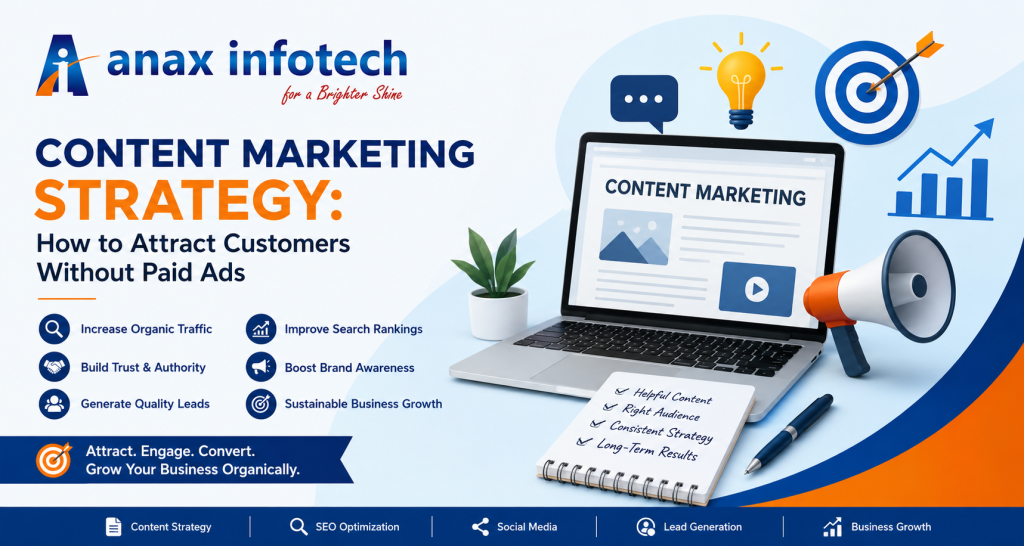
Paid advertising can generate quick visibility, but businesses often face a common challenge: once the advertising budget stops, the traffic can decline too. A well-planned content marketing strategy, on the other hand, can continue attracting potential customers through search engines, social media, referrals, and valuable online resources.
For businesses looking to increase organic website traffic and generate quality leads without paid ads, content marketing provides a sustainable way to build online visibility, authority, credibility, and customer trust.
What Is Content Marketing?
Content marketing is the process of creating and sharing useful, relevant, and valuable content to attract a specific target audience. Instead of directly asking people to purchase a product or service, businesses answer their questions, solve their problems, and provide information that helps potential customers make better decisions.
Content marketing can include:
- SEO blogs and informative articles
- Service-related guides and tutorials
- Case studies and success stories
- Infographics and visual content
- Videos and short-form content
- Social media posts
- Frequently asked questions
- Industry reports and expert insights
Why Content Marketing Can Generate Customers Without Paid Ads
People often search online before contacting a company. They may search for solutions, compare providers, read reviews, investigate pricing, or look for answers to specific problems.
If your website consistently provides useful answers, your business can appear during these research stages. Over time, valuable articles and resources can continue attracting visitors through organic search without requiring you to pay for every click.
This makes quality content an important part of a long-term organic marketing strategy. When combined with SEO and conversion-focused website optimization, content can become a valuable source of qualified website traffic and leads.
1. Understand What Your Customers Are Searching For
Successful content marketing starts with your audience, not with random keywords. Before creating content, identify the questions, concerns, and problems your potential customers have before purchasing your product or service.
For example, potential customers may search:
- How does SEO help small businesses?
- How much does website development cost?
- How can I generate leads online?
- What is the best digital marketing strategy for my business?
- How can you improve Google search rankings?
These questions reveal search intent. Create content that answers these questions clearly, naturally, and with practical information.
2. Create Content Around High-Intent Keywords
Not every keyword will bring valuable customers. Focus on keywords connected to your services, products, customer problems, and purchasing decisions.
Instead of targeting only a broad keyword such as “digital marketing,” create useful content around specific searches such as “digital marketing services for small businesses” or “SEO company for local businesses.”
Long-tail keywords may have lower search volume than broad keywords, but they can attract visitors with a clearer business requirement and stronger purchasing intent.
3. Build Topic Clusters
One blog should not be your entire content strategy. Build a collection of connected articles around important topics related to your business.
Connect related articles using internal links. This helps visitors discover more useful information while creating a stronger website structure and making it easier for search engines to understand the relationship between your content.
4. Turn One Idea Into Multiple Content Formats
You do not always need to create completely new content for every marketing platform. A detailed blog can be repurposed into multiple formats.
- LinkedIn posts
- Instagram carousels
- Facebook posts
- Short-form videos
- YouTube Shorts
- Infographics
- Email newsletters
This content repurposing strategy helps businesses reach different audiences while reducing the time and resources required to produce fresh content.
5. Use Real Experience Instead of Generic Content
The web is already crowded with repetitive and generic information. Businesses can stand out by sharing practical knowledge, real examples, processes, lessons learned, results, and industry insights.
For example, instead of simply writing “SEO is important,” explain how your team approaches keyword research, technical SEO, content optimization, local SEO, reporting, and lead generation.
Original experience makes content more useful to readers and can help establish your business as a knowledgeable and trustworthy source within your industry.
6. Optimize Content for Search and Users
SEO should support useful content—not replace it. Your primary keyword should be used naturally in important areas such as the title, introduction, headings, URL, and relevant sections of the article.
Also pay attention to:
- SEO-friendly title and meta description
- Clear heading structure
- Relevant internal links
- Descriptive image alt text
- Page loading speed
- Mobile-friendly design
- Clear calls to action
The goal is to make your content easy for both users and search engines to understand while keeping the information natural and genuinely helpful.
7. Add Strong Calls to Action
Website traffic alone does not generate revenue. Your content should provide visitors with a clear next step when they are ready to engage with your business.
Your CTA should match the visitor's intent. Someone reading an introductory guide may need more educational information first, while someone comparing service providers may already be ready to request a consultation.
8. Measure What Generates Leads
Do not measure content marketing success only by page views. Track the metrics that show whether your content is contributing to business growth.
- Organic website traffic
- Keyword rankings
- Search impressions
- Click-through rate
- User engagement
- Contact form submissions
- Phone enquiries
- Consultation requests
- Leads generated from individual pages
Measuring these results helps you identify which topics attract visitors and which content actually contributes to qualified leads and business opportunities.
Build Sustainable Organic Growth With Anax Infotech
Content marketing is not a shortcut to instant traffic. It is a long-term strategy for building organic visibility, authority, trust, and quality leads.
At Anax Infotech, businesses can combine content marketing with SEO, website optimization, social media marketing, and conversion-focused strategies to create a stronger digital presence.
Instead of continuously paying to reach new audiences, businesses can build valuable content assets that attract potential customers repeatedly through organic search and other digital channels.
A consistent strategy focused on customer needs, useful information, search intent, and measurable results can turn your website into a long-term source of qualified traffic and enquiries.
Ready to Attract More Customers Without Depending Entirely on Paid Ads?
Build a content marketing strategy designed around your business goals, target audience, SEO opportunities, and lead-generation objectives.
Contact Anax InfotechFrequently Asked Questions About Content Marketing
Can content marketing attract customers without paid advertising?
Yes. High-quality content can attract visitors through organic search, social media, referrals, and other unpaid channels. Results usually depend on content quality, consistency, SEO, competition, and how well the content matches customer search intent.
How does content marketing help generate leads?
Content attracts people who are actively researching a problem or solution. By providing useful information and including relevant calls to action, businesses can move visitors from information discovery toward enquiries, consultations, and purchases.
What type of content is best for SEO?
The best content is content that satisfies a genuine user need. Depending on the business, this can include detailed blog posts, service pages, guides, FAQs, case studies, comparison content, and other resources that provide useful and relevant information.
How long does content marketing take to generate results?
Content marketing is a long-term strategy. Results can vary depending on competition, website authority, content quality, keyword difficulty, publishing consistency, and SEO implementation. Businesses should evaluate progress using traffic, rankings, engagement, and lead-generation metrics rather than expecting instant results.
Contact Anax Infotech today to boost your local visibility with expert GMB optimization services.
 Call: +91 92712 33 333
 Email: info@anaxinfotech.com
 Website: www.anaxinfotech.com
 Visit us at our office in Thoothukudi
Follow us on Facebook & LinkedIn for the latest marketing insights and trends.
Contact us today and take your business to the next level.